
Troy Previous Residents by Era
A Troy address has two trails: ownership and occupancy. The Rensselaer County Clerk holds the recorded land record, while the Troy Room, Hart Cluett Historical Society, maps, newspapers, and census material can place past households in time. Begin with the most recent parcel identifier and do not assume that an owner was a resident. Likewise, a directory listing is a period lead, not proof of title. The useful starting source changes with the period, especially around the online image boundary and the shift to address-first directory research.
| Source | Years It Covers | Where Held | What It Shows |
|---|---|---|---|
| Albany County deed context | Pre-1791 | Albany County historical records | Earlier jurisdiction before Rensselaer County |
| Rensselaer deed indexes | 1791-present | County Clerk and historical deed guide | Grantors, grantees, deed books, pages, and legal descriptions |
| Troy city directories | TPL 1829-present; HCM 1832-1999 | Troy Room and Hart Cluett | Period names, addresses, occupations, wards, and removals |
| Troy House Directory | 1915 onward | Troy Room and Hart Cluett | Address-first household leads |
| County index books | 1973-1989 | County Clerk route | Grantee data only in the published online schedule |
| Real-property records | 1989-present | County Clerk online route | Data and images in the published schedule |
For a recent transfer, bridge the street address to the SBL, then use the recorded instrument. For an older household question, choose a directory year before choosing a census schedule or newspaper. Pre-1791 work needs an Albany County jurisdiction check. The historical Rensselaer deed guide is useful for locating deed-book and Family History Library film references, but the County Clerk is the official custodian for the instrument. Keep the year, source role, and uncertainty beside every name.
Note: Choose the source by period before drawing a conclusion, because online images, historical books, and directories cover different intervals.
Troy 1915 House Directory
The 1915 House Directory is Troy's practical address-first turning point. Hart Cluett describes the earlier directories as name-first through 1914, then identifies the House Directory as the route for address research. Use the printed building number and street form first. A result can supply a name to test in the annual directory, its street guide, ward material, or a newspaper. It should not be treated as a complete count of everyone in a dwelling.
The Troy Room's local-history collection reports nearly complete printed city directories from 1829 to the present, along with newspapers and census material. Some online full-text directory years are missing, so an absent scan is not proof that a person or address was absent. Compare the surrounding years, including three-to-five-year intervals when a surname disappears. Preserve abbreviations such as h., cor., and opp. exactly as printed, then explain them separately in research notes.
Note: The House Directory supplies an address lead, while a deed and assessment record answer different questions about title and parcel identity.
Troy Past Residents From SBL
Start a backward address trail in City PROS with the current SBL, the parcel identifier used in the property system, address, or owner name. The portal advises that one criterion often works better than combining several. Save the SBL, situs address, assessment year, owner name, and map link. A situs address identifies the property itself; an owner mailing address is a contact location and may be elsewhere. That distinction prevents a recorded owner from being presented as someone who lived at the Troy address.
Next, keep the SBL with the municipality, SWIS, section, and tax-map reference. The City PROS TaxMap index exposes municipality, section, and sub-section controls, and Troy uses SWIS 381700. Those parcel keys can reconcile a street label that changed, a lot shown on a map, and a legal description in a deed. Assessment information is a dated roll snapshot, so the transfer itself still needs a County Clerk instrument.
Trace Troy Previous Residents in Deeds
The current SBL creates the bridge to the Rensselaer County Clerk's land records. Search the current owner as grantee, inspect the purchase deed, and take the seller's name and the deed's legal description into the next lookup. The seller was the grantor on the current deed and may appear as a grantee on an earlier purchase. Repeat the change in direction one transfer at a time. Record the instrument number or book and page, recording date, deed type, parties, legal description, and whether an image was available.
- Use City PROS to capture the current SBL and owner as a starting point, not as final title proof.
- Search the owner as grantee in the land-record route and inspect the latest available deed image.
- Copy the grantor, legal description, recording key, and any prior deed reference from that instrument.
- Search that grantor as a grantee to locate the earlier acquisition, then repeat the reversal.
- When the online record is index-only or absent, request the older book, film, or index path through the Records Room, library, or FamilySearch route.
- Grantor / grantee
- The grantor transfers an interest in the deed; the grantee receives it. Their mailing details can differ from the property address.
- Chain of title
- A dated sequence of recorded transfers for one parcel. It tracks ownership evidence, not every person who occupied the address.
- Legal description
- The parcel wording in a recorded instrument, such as lot or map references. It can stay more stable than an older street label.
The county identifies NY Land Records as the online land-record route, but its current login, payment, and field sequence were not exposed in the research inspection. The County Clerk's Records Room at 105 3rd Street is the in-person route for deeds and older indexes. Ask the custodian about the needed book, year, and copy method before relying on a missing online image.
Troy Land Records Date Boundary
The published County Clerk availability schedule sets a meaningful divide for Troy previous residents research. Real-property data and images are listed from 1989 forward. The 1973-1989 index books have grantee data only, so a researcher may need an in-person grantor-to-grantee trail, a later deed, or an assessor bridge. Older deed indexes reach back to 1791, but books and films are a different access path. The schedule does not justify assuming a scanned image is available for every historic entry.
| Route | Best use | Limitation |
|---|---|---|
| 1989-present online real-property route | Modern recorded data and images | Current owner does not establish prior occupancy |
| 1973-1989 index books | Grantee-side lead for an earlier transfer | Published as grantee data only |
| 1791-forward deed books and films | Earlier grantor/grantee and legal-description work | Separate book, film, or custodian access |
This contrast is important: newer image availability is not the same thing as deeper historical coverage. The County Clerk's published availability schedule is the appropriate check before describing a search result as image-accessible. A pre-1791 transfer belongs in the Albany County context, even when a later parcel is now in Troy.
Troy Sanborn Maps for Residents
Maps help explain where an address sat at a particular time. They do not identify occupants. The 1903-04 Sanborn volume covers Troy, Green Island, and Watervliet in 82 sheets, while Troy Room and Hart Cluett holdings add later map context. Pair a map sheet with a directory date, the current SBL, and the deed's legal description. That three-part check is especially helpful when a structure has changed or a street label seems unfamiliar.
See the historical deed-index and film route in the Rensselaer historical deed guide before using the image below to choose the next book or film reference.
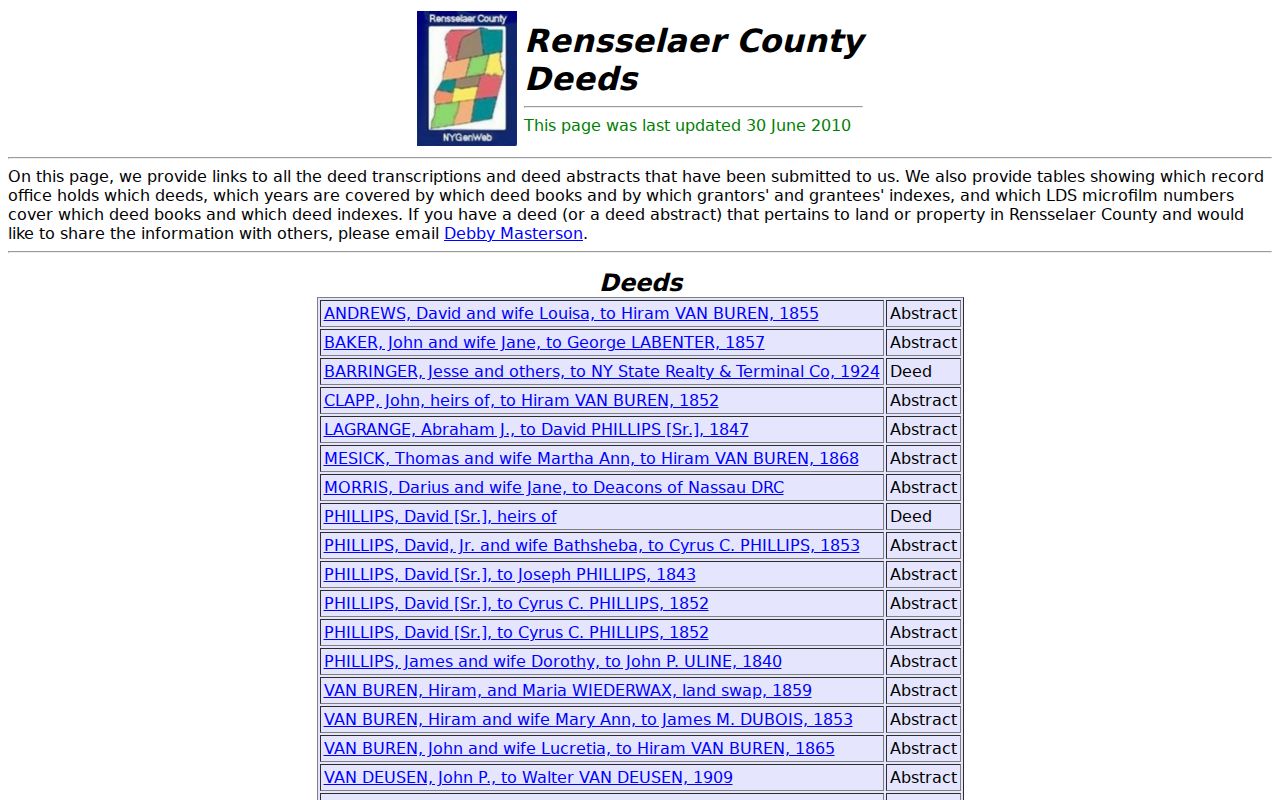
The guide is a locator for historic index and film research. It complements, rather than replaces, an inspection of the recorded deed and the parcel evidence that ties the document to a Troy address.
Troy Lansingburgh 1900 Transition
Historic Lansingburgh was an independent village with a 1770 grid and a 1788 expansion before its 1900 annexation to Troy. Older directories, newspapers, deeds, and maps can therefore use Lansingburgh language where a later record uses Troy street or ward terms. Search both place names, then compare the street, block, lot, or legal description. Do not treat an apparent name change as a proven renumbering because the research did not locate a complete official citywide crosswalk.
The most careful record trail keeps the source's original wording beside a normalized modern address. A map can establish period orientation; it cannot turn a historic block label into evidence that the same household remained there after annexation.
Note: Lansingburgh terminology is a period clue, not a separate modern parcel jurisdiction without a matching map or assessor record.
Troy Probate for Past Owners
A deed chain sometimes pauses at an estate. In that case, probate can clarify the recorded role without turning a family relationship into a guess. WebSurrogate supports available public name, file, old-index, index-book, and will searches, while Hart Cluett and Troy Irish Genealogy sources are valuable for Rensselaer probate from 1791 to 1915. Later courthouse material is the confirmation route. Record the file number, role, AKA, and date of death where available.
Probate may connect a deceased owner to an executor, heir, or estate transfer. It does not prove who lived in the building, and a same-name result needs a matching address, date, or legal description. Newspaper obituary and cemetery indexes can offer a date lead, but the underlying court or vital record remains the stronger confirmation.
Troy Past Households in Directories
Ownership alone cannot answer who lived here before. Annual Troy directories can supply a name, address, occupation, ward, and occasional removal notation. The House Directory adds an address-first route from 1915. Federal census holdings cover 1790-1940, and the Troy Room also holds New York State census microfilm for selected years. Treat each source as a dated time slice. A name at an address in one volume does not establish a household for every year around it.
Use a simple flow: directory year and address line → nearest census date → adjacent directory year → newspaper, cemetery, or probate follow-up. A census can test the household at the relevant enumeration date, while the later sources may explain a departure or death. The collection details belong with the Troy city directory materials, while the backward address trail stays focused on matching people to a defined place and date.
- Choose a House Directory year for an address-first search, or a name directory year before 1915.
- Save the printed building number, street wording, name, ward clue, and any removal notation.
- Check the nearest federal or New York State census holding as a separate household time slice.
- Compare an adjacent directory year before deciding that a person arrived, left, or died.
- Use newspaper, cemetery, or probate material to pursue a documented endpoint rather than infer one.
Records can describe owners, directory entries, court roles, or historical households. Keep those roles separate, and avoid publishing information about living people beyond what is needed for lawful personal house-history or family-history research.
Lawful use. Troy house-history research is for personal, family, and property-history questions. Do not use a historical trail to watch, harass, or harm any living person.